
How to read 203 sends, seven qualified replies and two deals: evidence and limits
The four-week pilot recorded 203 sends, seven qualified replies, two meetings and two deals. This is one anonymous retail-media company’s record, not evidence of manufacturing response rates or the effect of AI alone. Its useful lesson is how to inspect conditions and responsibilities across the sales process.
THE ESSENTIALS
How did we evaluate results from 203 sales emails?
- The 203-send result is one retail-media company over four weeks.
- Keep the interim 173 figure distinct by timing and denominator label.
- Transfer the evaluation method to manufacturing, not the conversion numbers.
Explore the sections5 sections
- Sends
- 203
- Qualified reply rate
- About 3.4%
- Meeting rate
- About 1.0%
- Deal rate
- About 1.0%
Results and measurement scope for 203 sends over four weeks
The published case concerns new business for an advertising service operated by an anonymous retail-media company. Over four weeks it recorded 203 sends, seven qualified replies, two meetings and two deals. All rates below use 203 sends as the denominator.
Scroll horizontally to view the table.
| Metric | Count | Rate out of 203 sends |
|---|---|---|
| Qualified replies | 7 | About 3.4% |
| Meetings | 2 | About 1.0% |
| Deals | 2 | About 1.0% |
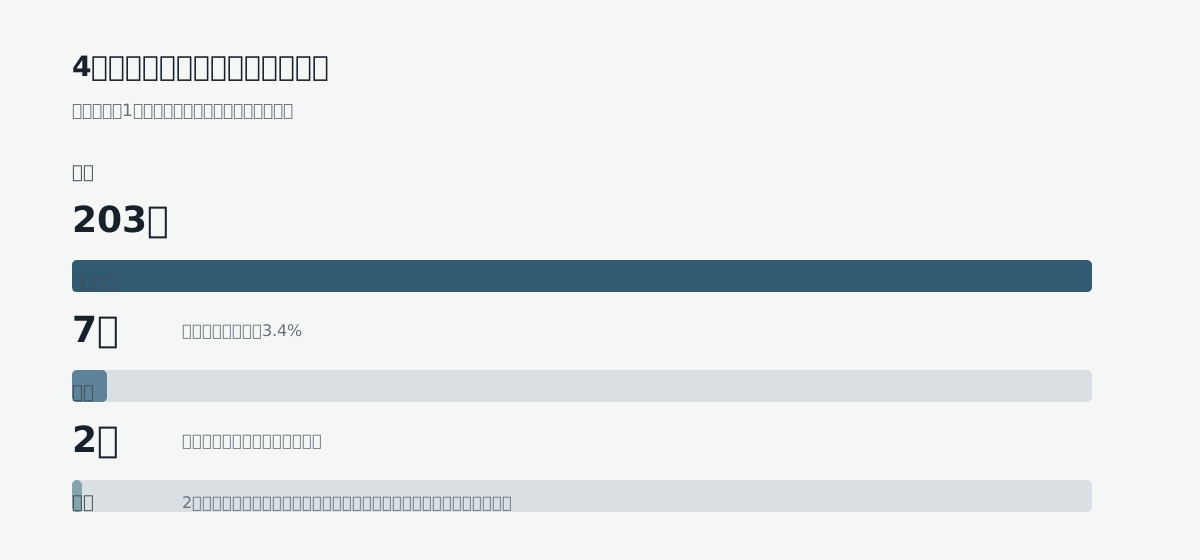
Seven divided by 203 is approximately 3.45%; two divided by 203 is approximately 0.99%. The displayed values are about 3.4% and 1.0%. Align denominators before comparing these with delivered-message or replying-company rates.
The public record does not disclose all prospect attributes, costs or meeting content. It does not contain everything required to assess repeatability or profitability.
- Four-week result
203 sends for one retail-media company.
- Interim record
173 valid sends, with a different observation point and denominator label.
- Separate manufacturing case
107 delivered and four qualified replies concern another company and period.
Do two wins from two meetings predict 100% conversion?
Both recorded meetings became deals, but there were only two meetings. That does not establish the outcome of the next one. If a hypothetical third meeting did not convert, the ratio would be two out of three. One outcome changes a small sample substantially.
The result reflects the target, timing, offering, proposal and staff response. It was not a controlled comparison with another method, so it cannot establish how many additional deals AI caused.
Revenue, gross profit, implementation cost and staff time are not published. A payback period cannot be calculated from this record, and deal count cannot be substituted for profit.
Keep the interim 173 figure separate from the final 203
The interim report recorded 173 valid sends, six replies, two meetings and one order. At four weeks, the final report recorded 203 sends, seven qualified replies, two meetings and two deals. Sending, replies, meetings and closing occur at different times.
The reports also use different send and reply labels. It would be incorrect to attribute the additional deal to the final 30 sends. An earlier contact may have closed later, and public totals cannot reconstruct every opportunity’s sequence.
For your own pilot, record send date, first qualified response, meeting date and deal date by opportunity. Compare consistent observation windows and keep active consultations separate from lost opportunities.
Preparation handled by AI and sales handled by people
AI supported company research and message drafting. Staff checked recipients and wording before sending. The customer’s employees explored needs and made proposals in meetings.
The deals are therefore not attributed to AI alone. Human participation also does not demonstrate that preparation support was unnecessary. Since the published totals cannot isolate causality, we report responsibilities alongside outcomes.
The pre-send review describes that pilot’s operating method, not every current service approval or automation option.
Transfer the evaluation method to manufacturing, not the rates
Advertising services and component machining have different purchasing conditions. Manufacturing requires materials, dimensions, quantity, quality and delivery to be checked. A reply does not establish suitable work.
In a separate metalworking case, the highest-volume sending week, September 21–27, 2026, recorded 107 delivered messages and four qualified replies, or 3.7%. Two quotation requests recorded in the retrospective cover a different period. Their machining conditions did not fit, and they had not produced orders at the retrospective. Combining the cases would not create manufacturing deal evidence.
For manufacturing, separate sends, qualified replies, confirmed conditions, quotation eligibility and orders. Record exclusion reasons and human review time. The pilot KPI guide explains how to fix comparison conditions in advance.
Who this is forPeople reviewing AI-assisted prospecting results and their limits
Results from one engagement cannot serve as general sales-email benchmarks or predict other engagements.
Evidence and sources
Recalculated from the published anonymous retail-media pilot, with a separate published manufacturing case for comparison. No private customer information or unpublished costs were used.